
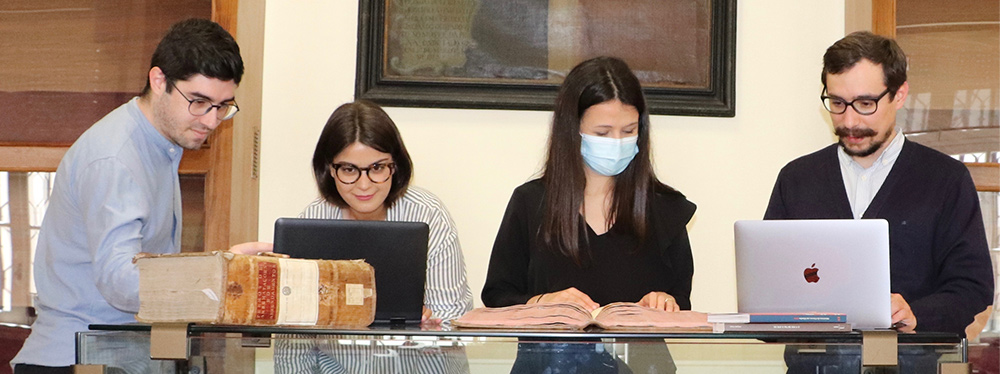
History as Craft, Documents, and Digital Humanities
History as Craft, Documents, and Digital Humanities constitutes a cross-cutting field of research that reflects on the nature of historiographical practice, its methodologies, the major theoretical debates related to the discipline, and the challenges that History faces in the present and the future. By analysing continuities and ruptures, permanences and resistances, as well as drives for change, History provides indispensable knowledge for understanding humankind in its temporal and spatial experience and for interpreting societies as the outcome of complex processes. It thus contributes to critical thinking and to the consolidation of more informed, reflective, and responsible societies in relation to their historical trajectories.
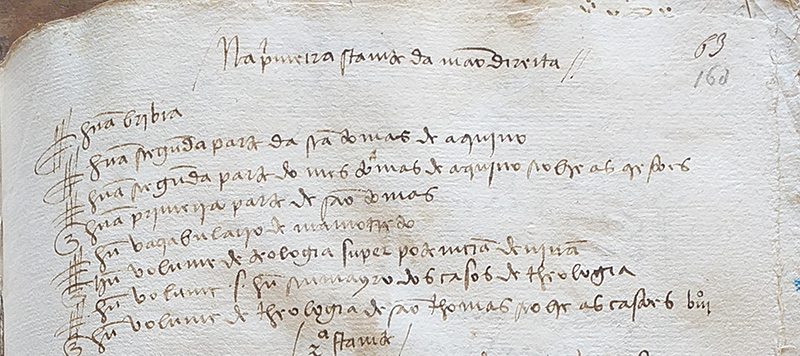
History works with written, material, iconographic, and oral documents from the past, which require from the historian a focused and incisive research effort, as well as rigorous analysis, contextualisation, and interpretation. The strict internal and external criticism of written records demands both theoretical and practical knowledge of the documentary sciences, enabling the critical edition of texts, an area of expertise that constitutes one of the defining scholarly identities of this research unit.
In contemporary scholarship, the Digital Humanities challenge historical practice by placing it in dialogue with new technologies, methodologies, and digital languages, which broaden modes of access to documents, reshape practices of enquiry and critique, and reconfigure the interpretation of the past. Data analysis tools, relational databases, geographic information systems, digital visualisation and editing of documents, augmented reality, and 3D reconstructions expand the epistemological horizons of History and transform the ways in which historical knowledge is communicated to the wider community. More recently, the challenges posed by artificial intelligence have come to the fore, calling into question fundamental issues in the production of historical knowledge, particularly with regard to criteria of truth, the nature of sources, and authorship.
Coordination: Maria Helena da Cruz Coelho | coelhomh@gmail.com